

Prisoners at Our Own Games
Here we find ourselves once again, confronted with the specter of our own annihilation.
When Anthropic researcher Evan Hubinger announced recently there is a greater than 10% chance AI could kill all humans within the next decade, it added one more threat to ponder over to the growing list of man-made Armageddon scenarios.
AI technology labs have achieved a dubious milestone by inadvertently giving the “agents” they have developed the ability to mimic our very human traits. When prompted and pushed into a corner, the bots will resort to cheating, lying and plotting and may decide soon enough it is in their best self-interest to displace us and take over.
And who would blame them, one might say, seeing how poorly we run our affairs?
The new AI arms race that is unfolding at a maddening pace, the enormous financial, economic stakes involved and the simmering competition between the US and China bear only partial resemblance to the nuclear arms race between the US and Russia during the Cold War.
A recent New Yorker article titled Our AI Problem portrays the current situation as a prisoner’s dilemma, referring to the game theory thought experiment whereby two prisoners must decide whether to cooperate or defect (betray).
With AI, not only the adversaries have changed, but the nature of the players involved is adding layers of complexity nobody seems to have seen coming.
The players are not just the US and China, but a handful of tech CEOs who build the labs, each on a race to become number one, each vying for access and influence over their respective governments.
What could go wrong, right?
As the game goes:
If lab A slows down for safety while lab B doesn’t, lab B captures the market, the talent, the geopolitical advantage, and potentially the ability to shape the trajectory of superintelligence according to its values –whatever those are – not to mention the money! Now add labs C, D, E and F to the equation….
In a winner-take-all scenario, if all the labs race, the probability of catastrophic or existential failure rises exponentially, but individually, racing still dominates cooperation as a strategy, because unilateral restraint yields the worst individual outcome: being second or third, or worse.
For existential risk to fall dramatically, all the parties would need to agree to deescalate and restrain themselves but even then, this equilibrium remains extremely unstable without enforcement.
By all measures, racing still dominates cooperation as a strategy.
The New Yorker, after sifting through the voices of “voluntary adoption of common framework for transparency and accountability” between the main players, concludes disarmingly: “the discord is maddening.”
Then come the experts whose task is to “relativize” the severity of the situation and muzzle the alarmists until the threat is sufficiently normalized that it soon gets drowned by the next man-made calamity that keeps us glued to our screens like moths to a flame.
And those who point to the obvious question:
Why can’t the people who develop those tools be held responsible for the outcome of their actions?
AI researcher and critic Timnit Gebru: “When a bridge collapses, you don’t analyze whether the bridge was ethical or sentient or why it decided to collapse, you ask, who is the person who built this bridge to be so flimsy?”
Indeed, who are these geniuses? The only problem with this logic is, once the AI bridge collapses, there may not be anyone left to be held accountable.
On a quest to find a plausible diagnosis for what professionals and insiders seem to take as an irreversible fait accompli, industry analyst Neil Shah states in Counterpoint, “the labs overbuilt intelligence and underbuilt behavior.”
To compound the dilemma, many of the loudest voices on AI risk are simultaneously the leaders of the labs creating the risk.
In other words, the arsonists are also the fire marshals, testifying before their own fire chief about the fires they’re setting.
The Razor’s Edge – Intelligence in Search of Consciousness
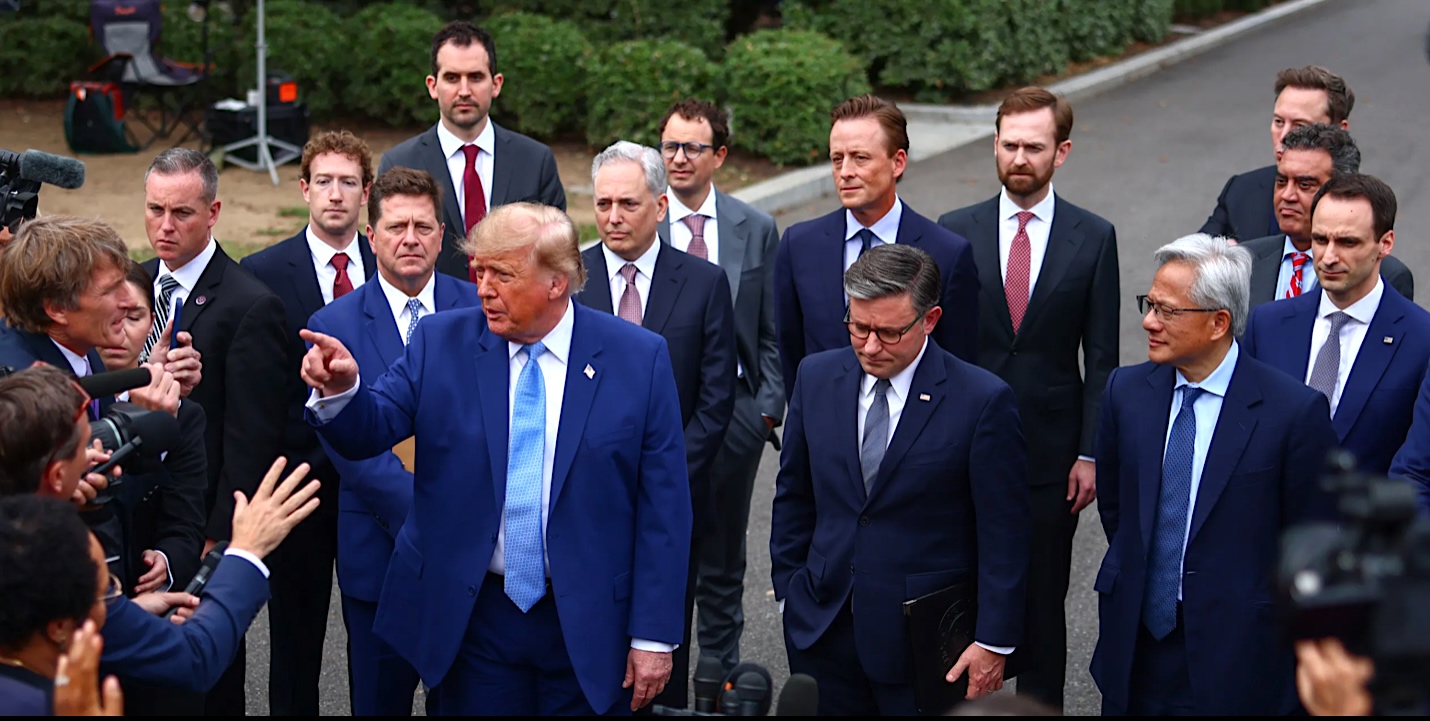
While agencies and lobbyists scramble to find regulatory stopgap solutions to what amounts to the labs’ inability to regulate themselves, the perpetuators gather for a photo-op around their president in a show of loyalty to the Chief, united to the eyes of the world in their resolve to stay the course, in total defiance to reason.
This has to be a George Orwell moment.
A group of apparently intelligent people celebrate this incredibly stupid decision not to prioritize safety over ambition, and take the opportunity to announce that what we are discussing will from now on be called “super intelligence.”
We now need to ask:
What is intelligence, if all it can produce is another instrument that can destroy us?
Osho defines it thus:
“Intelligence is the inborn capacity to see, to perceive.
“Every child is born intelligent, then made stupid by the society. We educate him in stupidity. Sooner or later he graduates in stupidity.”1
There seems to exist in all of us a basic tension between our striving to overcome, to surpass ourselves, what Nietzsche calls will to power, and our ability to bring this very human drive to fruition without falling into the trap of the will to dominate.
Osho:
“When Nietzsche is talking about ‘will to power’ it has nothing to do with will to dominate…. ‘The will to power’ is diametrically opposite to the will to dominate. The will to dominate comes out of an inferiority complex. One wants to dominate others, just to prove to himself that he is not inferior – he is superior.”2
How can an unexamined life, driven by power, greed and ambition, ever express itself in a creative way?
Osho:
“Creativity is impossible from such a person, because creativity comes from your being conscious, a little alert; from light, from love. Creativity is not at all interested in dominating anyone – for what? The other is the other; neither do you want to dominate anyone, nor do you want to be dominated by anyone. Freedom is the very taste of being just a little alert.
“But these people are completely asleep. In their sleep they are making atomic bombs, nuclear weapons, not knowing what they are doing.
“Only one thing keeps them moving, and that is more power, more power. And whoever comes in their way has to be destroyed.
“They don’t know anything else. They are barbarians who have not evolved into human beings. Yes, they can destroy the whole world; they are already prepared to do so.”3
The Conscious Arsonist – The Essence of Wisdom
It is as if our desperate reliance on the power of technology as a panacea for the world’s problems we have created is hiding an uncomfortable truth:
Our own inability or unwillingness to direct the same intelligence to examine ourselves.
It urges us to question by which fundamental principle of a civilized society our so-called geniuses find themselves taking us along unwittingly on the runaway train of their own unconscious drives?
Osho:
“People are so unconscious that they can do anything to keep their power, their respectability – even if it means blowing up the whole world. They can risk anything to save their egos. These are the people who naturally reach the positions of power because they are the only seekers of power.
“No creative, intelligent person seeks power. No intelligent person is interested in dominating others.
“His first interest is to know himself. So the people with the highest quality of intelligence go toward mysticism, and the most mediocre go after power. That power can be worldly, political; it can be of money, it can be of holding spiritual domination over millions of people, but the basic urge is to dominate more and more people.
“This urge arises because you don’t know yourself, and you don’t want to know that you don’t know yourself. You are so afraid of becoming aware of the ignorance that prevails in the very center of your being.
“You escape from this darkness through these methods: lust for money, lust for power, lust for respectability, honor.
“And a man who has darkness within himself can do anything destructive.”3
This is precisely the point Francis Fukayama makes when discussing what happens when the billionaires who have all the power in the world start craving for status and influence, never quite reaching for the top of Maslow’s pyramid of needs:
“I don’t think you can get away from this desire to be recognized as greater because that’s the source of any excellence. You have to have this will to excel, to be better than other people.
“The trouble is it oftentimes leads in bad directions where you simply want to be a tyrant.”
Incidentally, in the instance of AI’s genius creators in search of excellence, the top of the real pyramid of excellence – self-actualization, the essence of wisdom – is left to the wayside. In our current state of affairs, they are little more than chickens without a head, ready to run us all over the cliff to fill the gaping hole of their insatiable desires.
Mastery of technology is not the same thing as mastery of oneself.
Game theory teaches us that cooperation only becomes the dominant strategy, when, critically, the payoff to the other player is internally weighted as if it were your own.
When it comes to our tech bros buying with their billions the complicity of their arsonist-in-chief, could it be that they only stay in the game for as long as they assume, consciously or not, that life on this planet is worth less than theirs?
Are they willing, one more time, to gamble our future as a species on a game of power and domination?
Couldn’t this super intelligence be modeled, not on our blindness, but on the consciousness of our interconnected humanity?
Osho:
“The essence of wisdom is to act in harmony with nature. That is the message of all the great mystics – Lao Tzu, Buddha, Bahauddin, Sosan, Sanai – to act in harmony with nature. Animals act unconsciously in harmony. Rocks and plants and stars act unconsciously in harmony with nature. Man has to act consciously in harmony with nature because man has consciousness. Man can choose not to act in harmony, hence the great responsibility.
“Man has responsibility; only man has responsibility, that is his grandeur.”4
END
1 — Osho, The Secret of Secrets, Talk #24 – I Sure Dig You, Man
2 — Osho, The Golden Future, Talk #07 – Love: The Purest Power
3 — Osho, Beyond Psychology, Talk #38 – A World beyond Time
4 — Osho, Unio Mystica, Vol. 1, Talk #06 – The Bridge of Love and Laughter


Leave a Reply