

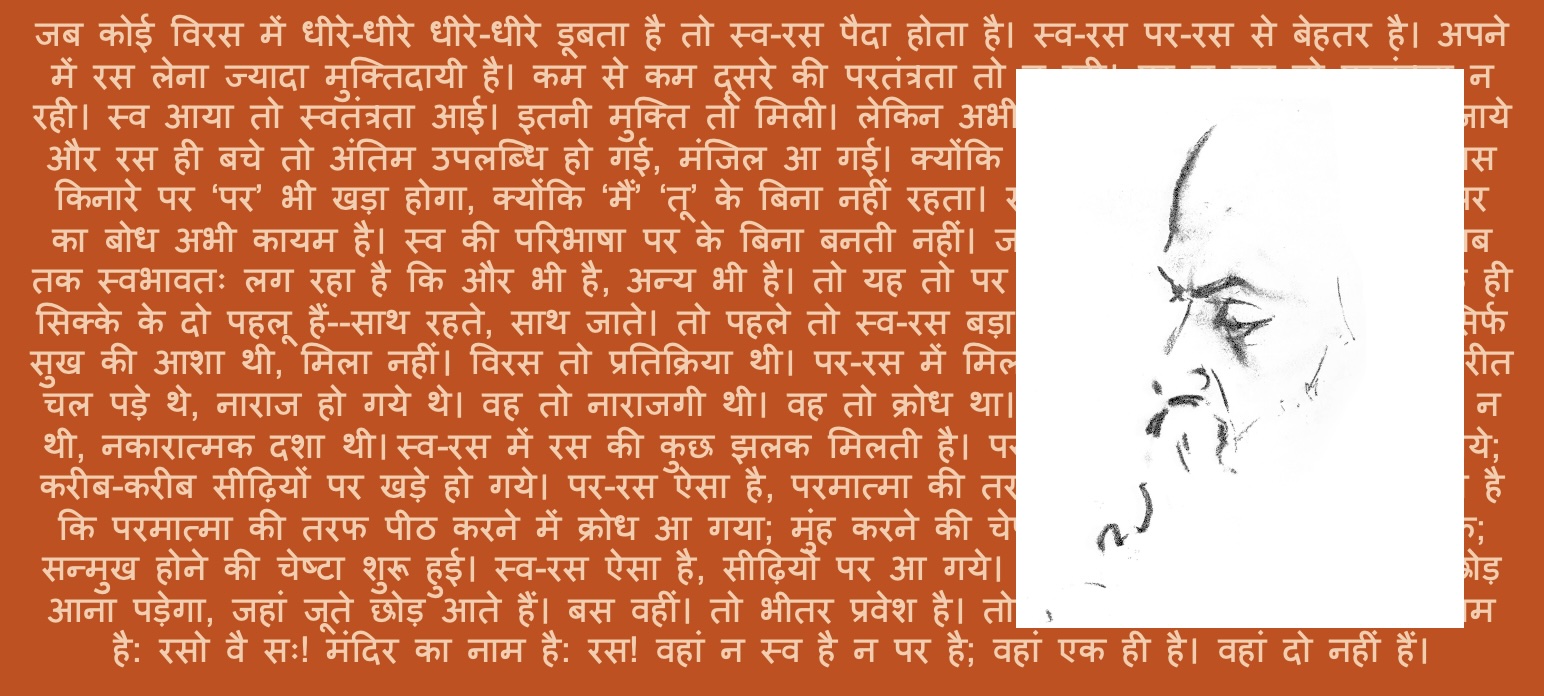
Gandhi used Hindi to express collective will – Osho used it to explore individual being
When Wild Wild Country came out on Netflix in 2018, Acharya Rajneesh – or Osho, as he came to be known – was, in many ways, exiled twice over. For an older generation, the documentary confirmed their unease as they were reminded that he had been a symbol of scandal, excess and the West’s dangerous fascination with Indian mysticism.
For many Indians, Osho remains an enigma – too spiritual for academic philosophy, too rational for religion and too unconventional for polite conversation.
But for anyone who studies the Hindi language, as I do, Osho cannot be ignored. As a linguist, I see philosophers as test cases for any language. A philosopher stretches a language to its limits. She does not just use it to communicate, she uses it to think. Through her, you see how flexible, how nuanced and how alive a language really is.
Osho did this for Hindi. His words were not borrowed or polished in translation. They were born in the rhythm of Hindi itself.
Hindi has always carried a peculiar anxiety about its identity. It is a young language compared to Tamil, Telugu and Sanskrit. It has neither the literary antiquity nor the classical status of India’s older languages, critics remind us. Its early literature is not really Hindi at all but belongs to languages such as Braj or Awadhi.
This argument has often fed a larger resentment, that Hindi’s rise was less organic and more political – a kind of imposition.
But that view misses something important.
In a short span of time, Hindi managed to free itself from the heavy shadows of Sanskrit and Persian.
Most languages evolve slowly, over centuries. Hindi leapt. It built its own voice quickly, plainspoken but capable of great subtlety. It became a language that could argue, question and reflect.
A tool for democratic expression
Part of this litheness came from Gandhi. Long before Osho, Gandhi used Hindi as a tool for democratic expression. For him, Hindi or Hindustani was not merely a language – it was a test of truth.
Gandhi’s experiments were not limited to moral conduct. They extended into speech and communication.
He saw Hindi as a language that had to earn its place by serving a moral and democratic purpose.
During the freedom struggle, Hindi was not simply a medium of slogans or translation.
It was a medium of trust between leaders and people.
It allowed a lawyer from Gujarat to speak to farmers in Bihar without sounding foreign. Gandhi believed that democracy needed a language that was rooted in the people. Hindi had to prove that it could speak both to power and to poverty.
This was not an easy task. Hindi had to stand against colonial English, which carried prestige and power. Yet Hindi flourished. It learned to bend without breaking. This flexibility became its moral strength. Gandhi’s use of Hindi in his speeches and writings made it a shared expression of democratic feeling. Hindi was part of his search for a collective voice.
Through Gandhi, Hindi had to prove it could serve a democratic people in a colonial world. It attained a moral stamina, the patience to face criticism and rejection.
A personal Hindi
Then came Osho.
Where Gandhi used Hindi to express collective will, Osho used it to explore individual being.
Where Gandhi’s Hindi was public, Osho’s was personal.
Where Gandhi’s Hindi united crowds, Osho’s led individuals inward.
Both used the same language, but for very different revolutions.
Philosophy demands precision. It requires a language that can hold paradox without fear and handle abstraction without confusion. For centuries, Tamil, Sanskrit and Pali carried that philosophical burden in India. Later, English took over in intellectual circles. Hindi was rarely seen as a serious language of thought.
Osho changed that perception.
In his early years, everything he said was in Hindi – thousands of pages of discourses and reflections, all flowing in the cadences of spoken Hindi. He talked about meditation, desire, power, freedom and death with an ease that felt both intimate and vast. He used words that ordinary people understood, yet arranged them in ways that opened unexpected meaning.
To either listen or read Osho in Hindi is to hear the language thinking aloud.
His syntax is conversational but his rhythm carries depth.
His sentences rise and fall like quiet waves.
There is a playfulness in his tone, but behind it, a deep exactness of thought.
Translating him into English often dulls this effect. In Hindi, his words breathe differently. They move with the natural pulse of thought itself.
A space of introspection
Through Osho, Hindi proved it could think, not just narrate. It could meditate, not just instruct.
After Osho, Hindi was no longer confined to politics or poetry. It had entered the space of philosophy and introspection.
That is no small achievement for a language still considered young.
Between Gandhi and Osho, Hindi revealed its entire range, from the political to the spiritual, from the collective to the self. Both experiments, though very different, strengthened the language in ways few others had.
That begs a question. Was Osho a philosopher who could have emerged only in Hindi, a thinker who could not have existed in another language? Or was he Hindi’s first true philosopher, the one who gave the language the confidence to think on its own terms?
Perhaps both are true.
Without Osho, we might still be wondering whether Hindi could produce a philosopher at all.
And without Hindi, Osho’s voice might never have sounded quite so human, or quite so free.
END
Krishna Kumar Pandey
Krishna Kumar Pandey is an assistant professor of Linguistics at the Central Institute of Hindi, Agra. He has been a Fulbright scholar at the University of Michigan.
This article is published in scroll.in


Leave a Reply