

The Coming Revolution – Intelligence vs. Stupidity
The arc of evolution of human intelligence has moved through multiple phases: early sensory adaptations to environmental pressures, social intelligence, symbolic intelligence – opening the door to abstraction from the present moment –, recursive intelligence with its capacity to self-reference and finally, systemic intelligence whose models are designed to extend cognition beyond its limits.
Each phase of this progression not only involves a deepening capacity for self-reflection, but its most salient feature is a clear pattern of accelerating recursion.
It took millions of years to go from stone tools to written language, thousands of years between written language and formal logic, centuries between formal logic and the insight into its neurological underpinnings and only decades between neuroscience and AI systems that model cognition. The interval between each new level of self-reference is compressing exponentially.
Consequently, looking ahead, if we were to extrapolate on the trajectory of this recursive self-modeling, it would be tempting to imagine that we will eventually reach a critical threshold where intelligence does not just model consciousness but recognizes it.
What we are contemplating within a short time span is a qualitative transition, a true awakening that the compression of the recursion timeline seems to render imminent.
Osho frames the challenge in unequivocal terms:
“The coming revolution in the world is not going to be of the poor against the rich, the proletariat against the bourgeois. The coming revolution in the world is going to be between the stupidity of humanity and the intelligentsia.
“Nobody has yet proposed the whole program, but that’s where I am leading you all: toward a new kind of revolution by human intelligence against human stupidity.”1
And:
“I make a difference between intellect and intelligence: Intellect divides things into opposites; intelligence penetrates into opposites and creates bridges.
Intellect makes walls; intelligence makes bridges.
“Meditation is the highest form of intelligence because it is the highest form of consciousness.”2
Are We There Yet? – The Map That Forgot It Is the Territory
Consciousness is the one thing every human being knows with absolute certainty exists — it is the precondition for knowing anything at all — and yet it is the one phenomenon that the modern scientific worldview is still struggling to account for.
The top contemporary cognitive scientists studying consciousness largely view it as an emergent, biological or computational process. They focus on neural correlates, predictive processing and global information integration.
Their consensus is clear: consciousness is just another name for the subjective experience produced by the brain.
A few examples:
- British neuroscientist Anil Seth sees consciousness or conscious reality as an hallucination of our brain.
- Cognitive neuroscientist Stanislas Dehaene proposes consciousness is a biological, computational process that gets “ignited” by stimulus in the brain.
- Psychologist Lisa Feldman Barrett describes consciousness as a “status report” from the brain and body, with the brain acting as a predictive organ whose function is to create a model of our physical environment.
- Cognitive science and psychology professor John Vervaeke investigates consciousness through the lens of “relevance realization” – how the brain dynamically creates meaning by selecting relevant information.
- Neuroscientist Robert Sapolsky contends that actions are entirely determined by prior biology, environment, and experience, thus reducing consciousness to a byproduct of neural machinery.
Physicists themselves, from their depth of understanding in the respective fields they study, fail to break free of the restrictive mold of our biology:
- Theoretical physicist Carlo Rovelli views conscious experience as arising from the evolutionary biological development of the brain.
- Astrophysicist Neil de Grasse Tyson dismisses consciousness as another word for awareness, defining it as “a distraction from the actions that people take in the face of stimulus.”
The irony of course is that every model, theory, or explanation of consciousness is itself a product of consciousness.
We are not standing outside the system looking in. We are the system.
This is not as a puzzle awaiting a clever solution but as a potential in-principle constraint:
The map cannot fully contain the territory when the map itself is part of the territory.
The View from Nowhere
What is modern science but a decontextualized mode of knowing, of making sense of our environment, of the world we live in?
Science operates solely on the reductive principle by which objective reality is defined:
“If it is not measurable, it does not exist.”
In classical physics, the observer is a passive witness. The universe is a vast machine running according to deterministic laws, and the observer simply watches it unfold. Measurement is, in principle, innocent. Its function is to reveal what is already here.
This method achieves spectacular success precisely by removing the observer from the picture, by treating the universe as a sophisticated clock that runs independently of anyone watching it.
From this perspective, the subjective experience, qualitative interiority – the very attributes of consciousness – are bound to be progressively demoted to epiphenomenon, illusion, or “mere appearance.”
Therefore, by its nature, the very method that masters the physical world renders invisible the one thing that makes any world appear at all.
The Prison of the Mirror
Humanity has been forever entrenched in the pernicious dualism of body and mind, inner and outer, good and evil, objective and subjective, seemingly unable to disentangle itself from its own self-deception.
Osho explains how this mis-alignment is also at the root of all division, of all sense of separation:
“The mind always wants duality. With the two the mind is absolutely at ease. The knower and the known… and the two always create the third, the knowledge. The observer and the observed are bound to create the third, the observation. And then there is no end to this infinite regress.”3
It took an Einstein, no less, to point to the restrictive prison of the subjective experience:
“A human being is a part of the whole called by us universe, a part limited in time and space.
“He experiences himself, his thoughts and feeling as something separated from the rest, a kind of optical delusion of his consciousness.
“This delusion is a kind of prison for us, restricting us to our personal desires and to affection for a few persons nearest to us. Our task must be to free ourselves from this prison by widening our circle of compassion to embrace all living creatures and the whole of nature in its beauty.”
Half a century later, philosopher and cognitive scientist David Chalmers, presupposing the very separation Einstein called a delusion, a separate physical world on one side and a separate conscious observer on the other, with an unbridgeable “explanatory gap” between them, formulated the hard problem of consciousness by asking: “How does objective reality give rise to subjective experience?”
The question builds upon the Cartesian paradigm by taking for granted that there are two separate realities, only to then puzzle over their connection.
If we don’t start with that separation as fundamental, the hard problem either dissolves or transforms into a very different kind of question.
To define the problem as hard is more a feature of our conditioned cognitive architecture than a revelation about the structure of reality, a limitation masquerading as a profound truth. The constraints of our reasoning only demonstrate that the classical framing is not just wrong but greatly incomplete.
Quantum physics has been quietly undermining this framing for a century.
The Observer as Constitutive, Not Incidental
The quantum revolution has shattered the classical assumption that measurement is innocent, that the observer is only a passive witness, that reality is revealed by measuring the objective world.
Quantum mechanics destroys this picture. A system exists in superposition – a cloud of potentialities described by a wave function – until a measurement occurs, at which point a definite outcome crystallizes.
We cannot step outside consciousness to study it because consciousness is constitutive of the system.
In classical framing, the circularity feels like a cage. The mind trying to understand itself is like a hand trying to grasp itself. The tool and the target are the same thing, and we are trapped. But the quantum observer–observed relationship reframes this entirely.
The act of observation doesn’t just reveal reality; it participates in specifying reality.
Osho explains that the division itself is illusory. It is only when the merging of the two into oneness is experienced that the witnessing consciousness arises:
“The observer means the subjective, and the observed means the objective. The observer means that which is outside the observed, and the observer means that which is inside.
“The inside and the outside can’t be separate; they are together, they can only be together. When this togetherness, or rather oneness, is experienced, the witness arises. You cannot practice the witness. If you practice the witness you will be practicing only the observer, and the observer is not the witness.”4
Contextuality — The Golden Key
Nothing exists independently of its context.
With this simple understanding alone, all divisions are dropped.
Osho:
“The witnessing consciousness is like the ocean at the time of the deluge. It has no coastline left around it; it is absolutely full – there is no boundary anywhere to it, it is limitless. But this is true only when divisions drop. As long as there is division, there are limits.”5
Or, as theoretical physicist John Wheeler succinctly puts it: “The boundary of a boundary is zero.”
In quantum mechanics, contextuality is formalized most rigorously through the Kochen-Specker theorem, which demonstrates that the properties of a quantum system do not possess definite, pre-existing values independent of the measurement process.
The context is not incidental to the result. The context is constitutive of the result.
Reality, at its most fundamental level, is not made of things with properties; it is made of relations, contexts, and participatory acts of disclosure.
Nothing exists of itself but in relation to the whole universe.
Osho takes the very notion of interconnectedness not only as fundamental to existence but also as the essential conduit, the vehicle through which transformation becomes possible:
“The very idea that all is interconnected makes transformation possible. If things are not interconnected then there is no possibility of any transformation. If the world consists of the philosopher Leibnitz’s monads – windowless, separate, atomic individuals, not connecting with each other at all because they are windowless – then there is no possibility of any transformation.
Transformation is conceivable only because you are me, I am you; we interpenetrate.
“Can you think of yourself as separate even for a single moment? You cannot even imagine yourself as separate.
“The flower cannot be separated from the tree; the moment it is separated it dies. The tree cannot be separated from the earth, the earth cannot be separated from the sun, the sun cannot be separated from other stars, and so on and so forth. You separate the leaf and the leaf dies. You separate the flower, the flower dies. You separate the tree from the earth, the tree dies. You separate the earth from the sun and the earth dies.”6
Consciousness is the paradigm case of contextuality.
The dominant scientific method, and indeed the entire framework of all body of knowledge accumulated through objective observation, is built on the ideal of decontextualization. To know something scientifically is to extract it from its particular context and describe it in universal, observer-independent terms.
A law of physics is supposed to be true regardless of who observes it, where, when, or under what conditions. The objective gaze, the view from nowhere, the God’s-eye perspective.
This has been the gold standard of knowledge since the Age of Enlightenment.
When scientists try to study consciousness scientifically, they immediately apply their reflexive training and turn it into an object with measurable, context-independent properties. They put subjects in fMRI scanners, correlate neural firing patterns with reported experiences, or try to isolate the “neural correlate of consciousness“, as if consciousness were a thing with a fixed address in the brain.
And this is precisely where the scientific method breaks down catastrophically when applied to consciousness.
Every one of these attempts at dissecting consciousness into its intrinsic parts strips away exactly what makes consciousness consciousness and reduces it to a functional property that resides or is generated deep in our brain, an advanced sensory feature of our evolved neocortex.
The implication is clear, if somewhat absurd: consciousness, narrowed down in its essence to the subjective experience emanating from an advanced biological organism, becomes by definition an individual phenomenon whose universal properties can only be studied in a lab.
As Scientific American plainly states in a piece titled Can plants have consciousness?, as if its author inadvertently inserted a self-destruct feature into its own argument:
“The fundamental challenge of studying consciousness remains: it’s hard to tell what consciousness is when you can only experience your own version of it. Scientists, in their quest to gather reliable data, have had to boil down consciousness to only factors that can be measured through experiments.”
Boiling down consciousness…. What remains?
What is left of the observation when the unobservable is left out?
Rather than treating consciousness as an anomaly that the mind is unable to comprehend and can only theorize about, scientists should investigate into the puzzle of their own ignorance.
They are after all the first ones to be faced with the limits of their own understanding. The deeper they peer into the very fabric of matter and the universe, the deeper the mystery.
Osho expands on this process of knowing “more and more about less and less”, pointing to its inescapable ultimate conclusion:
“The Western mind has been able to go into details. Because it has chosen a very small part, it can go into details. It goes on knowing more and more about less and less. Drawn to its logical conclusion, it can be said that the Western mind will finally reach to knowing more and more about nothing, because that will be the smallest part: nothing.
“Albert Einstein and the Neo-Physicists almost reached to that nothing. And they are puzzled because their minds cannot understand nothing, and they are confronting nothing. Their instruments have led them to nothing. Their analysis, their experiments have revealed “nothing” to them, but their minds are not ready to accept nothing.”7
How can the mind comprehend that which is not of it?
To get us out of this bind, Osho lays out his vision for the necessary synthesis of East and West, an integration of both, of mind into no-mind:
“What mind can understand is a very small part, and because it is only a small part, it is going to be dead, it is going to be material. That which is beyond mind has to be understood. The East has moved into the irrational, into the mystical, into the miraculous. And certainly, the Eastern approach is far wider, far bigger. It can contain the Western approach in it, but the Western approach cannot contain the Eastern. No-mind can contain mind, but mind cannot contain no-mind. That’s where the Eastern approach has reached to higher peaks….
“This small mind, which consists only of biology and sociology, cannot know the vast truth, the mysterious expanse of the ultimate.
“It is absolutely needed to transcend the mind. And in a strange way, the moment you transcend the mind, you for the first time understand the mind also. Because to understand anything you have to stand apart, a little distance is needed.
“A meditator can understand mind, and can understand no-mind, because he is standing apart, aloof, as a witness. He can see thoughts, and he can see the absence of thoughts, and he can understand that both are essential.
Thought is for the limited, and the no-thought is for the unlimited.”8
The Dissolution of the Hard Problem
The question is no longer “how does unconscious matter become conscious?” or “how does the brain manufacture consciousness?” but:
How does consciousness itself give rise to our experience of reality?
The answer cannot be found by decontextualized analysis for the same reason that quantum properties cannot be assigned context-independent values: because it does not exist in that mode.
The hard problem persists not because consciousness is a mystery but because we have been searching for it using the one method guaranteed to miss it: the method that strips away context, relation, and participation in pursuit of a view from nowhere that quantum physics itself has proven does not exist.
Osho:
“Logic is man’s imposition on reality.
“Reality is very illogical, mysterious; it does not follow any rules. And the deeper you go into it, the more and more you will become aware that maybe on the surface there are a few rules, but as you move deep, rules start disappearing. And there comes a point in the depth of reality where all rules are invalid.
“Physicists are coming to it, because they have penetrated deep into matter.
And they are talking almost like mystics. This is one of the greatest phenomena that have happened this century; It is this century’s contribution to human consciousness….
“Modern physics says the deeper we penetrate into matter, the more we come to know that all our imposed rules are inadequate. Reality is bigger than our rules. And reality is so vast that it contains contradictions. It is not linear; it does not move in one direction, it moves in all the directions simultaneously. There is no way to approach it logically. You have to drop all logic; modern physics has dropped all logic. It had to drop it; to be true to reality logic has to be dropped, otherwise you will not be true to reality, you will be true to a fictitious reality that you have created.”9
What is needed, then, is not a technological breakthrough. It is more akin to a homecoming, a return to the recognition that the deepest layer of reality is not dead matter shuffled by blind forces, but a living contextual field of awareness in which matter, mind, meaning, and measurement all co-arise and become reality.
Not consciousness explained by physics, and not physics explained by consciousness, but both recognized as inseparable aspects of a single contextual reality that can only be known by participating in it.
In this “participatory universe”, as physicist Wheeler suggests, the observer becomes a participant – he is actively involved in the construction of reality.
Quantum theorist Chris Ferrie sums it best:
“You may be inclined to believe that when you observe something in the world, you are passively looking at it just the way it would have been had you not been there. But quantum contextuality rules this out.
“There is no way to define a reality that is independent of the way we choose to look at it.”
If a tree falls in the forest….
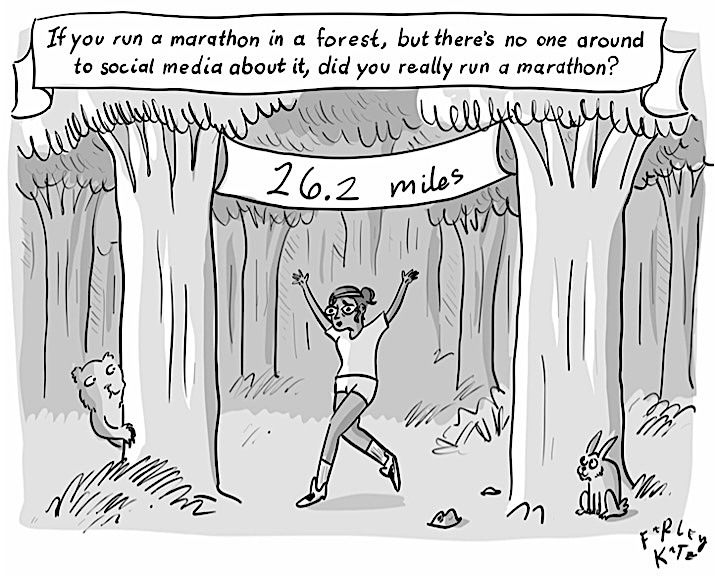
Consciousness is a contextual reality. It exists only in the relating, the way meaning exists only in the reading of a text, not in the ink.
We are not just passive observers of a pre-determined universe but active participants in an ever-evolving interdependent web that we call reality.
Osho:
“Consciousness is your intrinsic nature. You have not been away from it even for a moment. But your situation is like the darkness under the lamp. You can never go away from this light, this self-luminous consciousness, even if you want to, but you can live in the illusion that you have gone far away from it. In this world you can dream, but the dream can never be the reality.
There is only one reality, and that is your consciousness, your true nature.
“Consciousness is being. So, the first thing to remember is that nothing is yours except for consciousness. The moment this feeling has crystallized in you, sannyas is born – because just the feeling that someone or something can be yours is the very meaning of sansara, the worldliness or unconsciousness.”10
END OF FIRST PART
Stay tuned for Part 2 of this article titled “Consciousness at the Crossroads – AI and the Revival” that will take us on an exploration of consciousness beyond the mind and how artificial intelligence, in a counterintuitive way, could serve as consciousness’s most powerful via negativa.
1 – Osho, The Last Testament, Vol. 2, Talk #17 – Whirlwind of Awakening
2 – Osho, Om Shantih Shantih Shantih – The Soundless Sound: Peace Peace Peace, Talk #5 – Love Gives Your Legs a Dance
3 – Osho, Om Mani Padme Hum – The Sound of Silence: The Diamond in the Lotus, Talk #8 – In Stillness, You Disappear
4 – Osho, The Book of Wisdom, Talk #23 – Consciousness is Total, Pure Energy
5 – Osho, Finger Pointing to the Moon, Talk #7 – You Are the Knot
6 – Osho, The Secret of Secrets, Talk #5 – To Be One Again
7 – Osho, The Zen Manifesto: Freedom from Oneself, Talk#3 – To Wait, to Wait for Nothing
8 – Osho, The Zen Manifesto: Freedom from Oneself, Talk#3 – To Wait, to Wait for Nothing
9 – Osho, Take It Easy, Talk #22 – Search for Your Own Path
10 – Osho, Bliss, Talk #1 – Your Desires Are Your Hell


Leave a Reply